
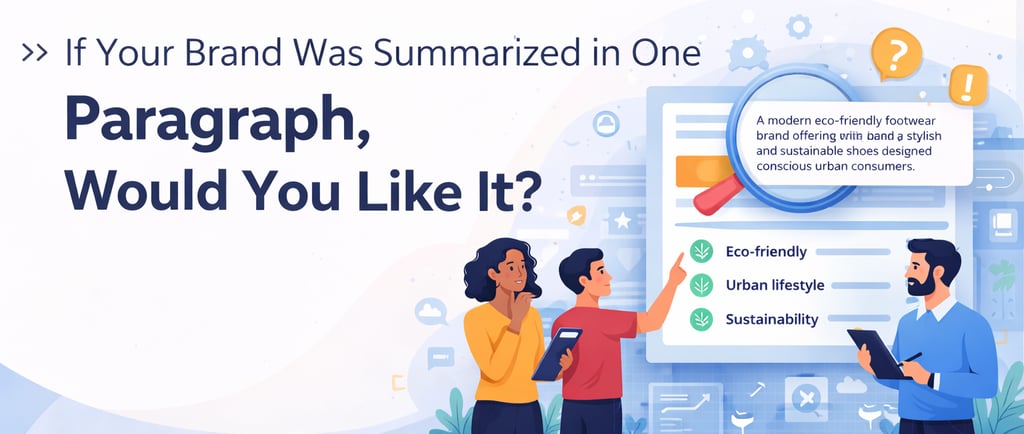
If Your Brand Was Summarized in One Paragraph, Would You Like It?
Whether you realize it or not, your brand is already being summarized. AI tools, search engines, social platforms, and recommendation systems constantly interpret who you are, what you do, and whether you’re worth trusting. That summary is formed from your website, content, visuals, messaging, and consistency over time. The uncomfortable question is simple: If that summary appeared in front of a potential customer, would it reflect what you actually stand for?
1/6/20262 min read
Brands Are No Longer Read. They’re Interpreted.
Most people don’t consume brands deeply anymore. They skim, scan, and rely on shortcuts.
AI accelerates this behavior. It doesn’t explore your brand the way a human might. It compresses you into meaning.
If your brand lacks clarity, the interpretation becomes vague. If your messaging is inconsistent, the summary becomes confusing. And if your positioning is weak, the brand becomes forgettable.
What Shapes That One-Paragraph Summary
Your brand is interpreted based on patterns, not promises.
These signals matter most:
How clearly you explain what you do
How consistent your messaging is across platforms
Whether your visuals feel intentional or random
How often your content reinforces the same idea
Whether your brand sounds confident or uncertain
AI doesn’t reward ambition. It rewards clarity.
Why This Exposes Weak Positioning Instantly
In the past, weak positioning could hide behind good design or aggressive marketing.
That’s no longer possible.
When everything is summarized, there’s no room for ambiguity. Brands that try to be everything to everyone end up being nothing to anyone.
A strong brand can be compressed without losing meaning. A weak one falls apart when simplified.
A Simple Test
Try this exercise:
Describe your brand in three sentences:
What problem do you solve?
Who is it for?
Why are you different?
If this feels difficult, unclear, or uncomfortable, that’s the gap AI will expose.
The Real Advantage
The goal isn’t to control every narrative. It’s to make sure the default interpretation works in your favor.
Brands that invest in clarity don’t fear summaries. They benefit from them.
Because when your brand is easy to understand, it’s easy to recommend.
The Brands That Win in 2026 Will Feel Boring on the Inside
The most successful brands of the next decade won’t look chaotic behind the scenes. They’ll look repetitive, structured, and almost boring internally.
That boredom is the advantage.
Consistency Is the New Competitive Edge
Great brands aren’t built on constant reinvention. They’re built on disciplined repetition.
The same ideas, expressed clearly.
The same visual language, applied consistently.
The same tone, reinforced over time.
From the outside, it feels cohesive. From the inside, it feels systematic.
Why Chaos No Longer Scales
Many brands confuse activity with progress.
They chase trends, redesign frequently, and change messaging often. This creates surface-level excitement but long-term confusion.
AI systems struggle with inconsistency. So do humans.
When a brand keeps shifting, it becomes harder to interpret, trust, and recommend.
Systems Beat Campaigns
Campaigns create spikes. Systems create compounding value.
Brands that win in 2026 focus on:
Clear brand frameworks
Repeatable content formats
Stable visual systems
Consistent narratives
These systems reduce decision fatigue internally and increase recognition externally.
Boring Internals, Memorable Externals
What feels boring inside a brand often feels familiar to the audience.
Familiarity builds trust. Trust drives choice.
The brands that stand out won’t be the loudest or most experimental. They’ll be the ones that show up the same way, every time, across every surface.
The Quiet Advantage
In a world full of noise, predictability becomes a signal of confidence.
The brands that win won’t be chasing attention. They’ll be easy to recognize, easy to understand, and easy to trust.
That doesn’t come from creativity alone.
It comes from discipline.
And discipline, almost always, feels boring on the inside.