
How Brands Get Discovered in an AI-First Internet
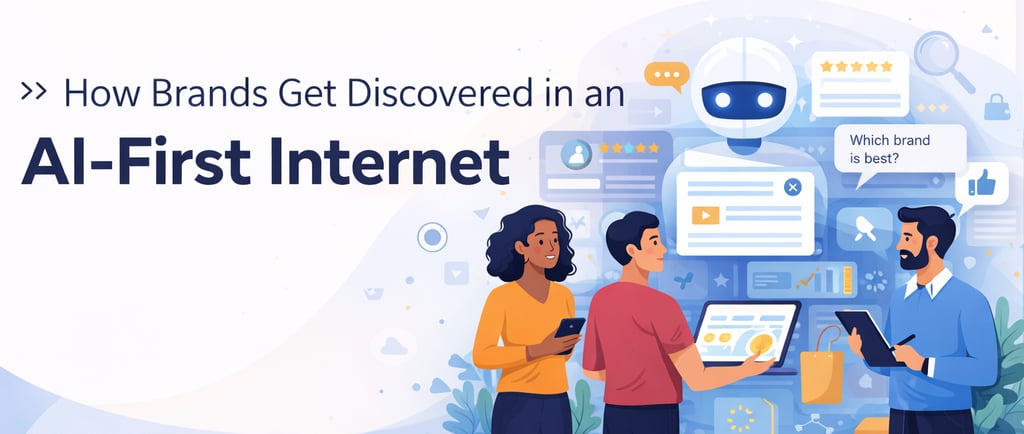
Discovery no longer begins with a search bar. It begins with a question, a conversation, or a recommendation generated by an AI system. In an AI-first internet, brands are not found by ranking higher. They are found by being understood. This shift has fundamentally changed how people encounter brands and how brands need to think about visibility.
1/6/20262 min read
The End of Linear Discovery
For years, discovery followed a predictable path: search, click, browse, decide.
That path has collapsed.
Today, users ask AI tools what to buy, who to trust, or how something works. They receive summarized answers, comparisons, and recommendations without ever visiting a website.
If a brand is not part of that answer, it effectively does not exist in that moment.
How AI Decides Which Brands Appear
AI systems do not “rank” brands the way traditional search engines did. They evaluate patterns.
They look for:
Clear explanations
Consistent messaging across platforms
Contextual relevance
Authority signals from content and structure
Brands that communicate clearly and repeatedly in a structured way are easier for AI to interpret and reference.
Why Brand Clarity Now Matters More Than Reach
In the past, visibility was about volume. More ads, more posts, more keywords.
In an AI-first internet, clarity outperforms scale.
If an AI cannot quickly understand:
What you do
Who you are for
Why you matter
It will default to another brand that communicates these things more simply.
Clarity is no longer a branding exercise. It is a discovery requirement.
Content Is Now a Knowledge Layer
Content is no longer just marketing output. It has become a knowledge layer that AI systems learn from.
Blogs, websites, social posts, and long-form content all contribute to how a brand is perceived, summarized, and recommended.
Disconnected content creates fragmented understanding. Structured content builds authority.
Discovery Happens Across Multiple Surfaces
Brands are now discovered through:
AI search results
Voice assistants
Social media summaries
Community conversations
Short-form video explanations
These surfaces are interconnected. A brand discovered through AI is often validated through social content or a website before trust is formed.
Consistency across these touchpoints matters more than ever.
Why Random Content Fails in an AI-First World
Posting frequently without a system creates noise, not visibility.
AI systems struggle with:
Inconsistent messaging
Contradictory positioning
Trend-only content with no depth
Brands that rely on isolated posts instead of content frameworks become harder to interpret and easier to ignore.
The Role of Brand Systems in Discovery
Brand systems create predictability.
They define:
Visual language
Tone of voice
Content structure
Narrative direction
This predictability makes it easier for AI tools to identify patterns and reference a brand accurately across different contexts.
Trust Is the New Ranking Signal
AI tools prioritize reliability over novelty.
Brands that:
Explain things clearly
Avoid exaggeration
Show depth and consistency
Are more likely to be surfaced as credible sources.
Trust is built through repetition, not virality.
How Smart Brands Adapt
Brands that thrive in an AI-first internet focus on:
Structured, intent-led content
Clear positioning across platforms
Fewer ideas, executed consistently
Systems over campaigns
They design for understanding, not just attention.
The New Discovery Advantage
The advantage no longer belongs to the loudest brand. It belongs to the most understandable one.
When a brand communicates with clarity, structure, and context, it becomes easier for AI systems to surface, summarize, and recommend it.
In an AI-first internet, discovery is not earned through clicks. It is earned through clarity.